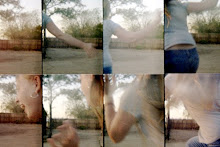
A grueling 3-4 mile marathon, Warrior Dash is an event held in locations all over the country where participants not only run the distance, but have a number of obstacles to overcome along the way. Costumes are encouraged, there's no time limit because it's not a race, and the prize? Not cash, but a beer and music to celebrate completing the feat!
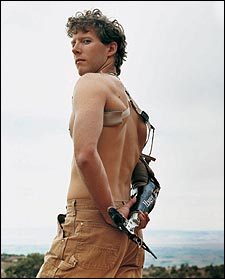
Aron Ralston is a 35 year old mountaineer and adventurer. In May 2003, on a solo hiking trip in Utah, was forced to amputate his lower right arm in order to survive when a boulder fell and trapped him. He was working as a mechanical engineer for Intel in 2002 when he left his job to climb all of Colorado's "fourteeners", or peaks above 14,000 feet. He spent five days trying to break or dislodge the boulder when on the fifth day, dehydrated and delirious, he prepared to amputate his own arm with just a camping multi-tool. After he freed himself from his trapped and dead arm, he was still 17 miles from his truck, to get to which first he had to rappel down a 65 foot sheer. Hiking through a canyon, he met a Swiss family on vacation who alerted the authorities to send a helicopter rescue team. Now with a prosthetic arm, he climbs more than ever, finishing his "fourteeners" as well as Denali, Kilimanjaro, and an expedition through the Grand Canyon. He intends to summit Everest one day, but for now is the subject of Danny Boyle's latest film, 127 Hours, about the true story of his 2003 accident.
Kent Jenkins is a college freshman at Loyola Marymount University in Los Angeles, who built himself a musical instrument out of pvc pipes, modeled after one used by Blue Man Group. Here's a video of him playing it :)
Arsenic, until recently, has been known as a universal poison to all types of life. But an organism found in California's Mono Lake can live and grow entirely off of this deadly chemical. The common element bacteria takes to survive is phosphorus, making it unheard of that this one thrives from such a toxic one. Until now, it wasn't believed that any such creatures could survive without phosphorus, being that it is one of the six essential components for the survival of all life. The reason this is of such interest to scientists is because it proves that life exists in harsher environments than we ever imagined. This is especially a big boost of hope for all those in search of intelligent life on other planets. Conditions that used to mean life was impossible...is now possible.
For the last five years, an aquarium in Kamakura, Tokyo, has powered a 6'6" tall Christmas tree by electric eel power. Inside the eel's tank is a pair of aluminum plates that act as electrodes to power the lights of the tree every time the eel moves. This year, they've added another display along with the tree that uses human power to work this time. Visitors stomp on a pad to make a Santa Claus robot sing and dance. The display's creator, Kazuhiko Minawa, imagines what the light produced by a Christmas tree powered by all the electric eels in the world would look like. But if you were to do that, why just power a Christmas tree?
In a small suburban backyard in Austin, Texas lies a structure made of lawn mowers, car parts, kitchen utensils, ladders, and pretty much anything else you can think of. It began in 1988 when its architect, Vince Hannemann, started building a clubhouse out of junk, which today he estimates measures over 60 tons of it. Visitors inquire about its significance, but Vince denies any profound meaning. He just did it for fun. He's happy to show visitors its climbing spires of trash and greenery should they be curious enough to come and see it.
Parkour, or free-running, is the practice of traversing elements in all settings, urban and rural. the goal is to move from one point to another as quickly and efficiently as possible by way of aerial rotations, spins, jumps, flips, and running. People who practice, called traceurs or traceuses, focus on developing physical fitness as well as speed, efficiency, and keen spatial awareness. According to one of the founders, David Belle, the idea is to move in a manner that gets you the furthest, fastest, as if you are running from or chasing something. Other than basic movements and techniques for beginners, there is no list of "moves" in parkour, since there is no particular field that traceurs practice. Every area presents new obstacles and challenges that are only overcome by training on the combination of multiple factors--angle, speed, body type, obstacle make-up, momentum, and absorption and redistribution of energy. It's a unique sport in that it relies on the body itself rather than any equipment. So, enough of the boring explanation. VIDEO TIME.